

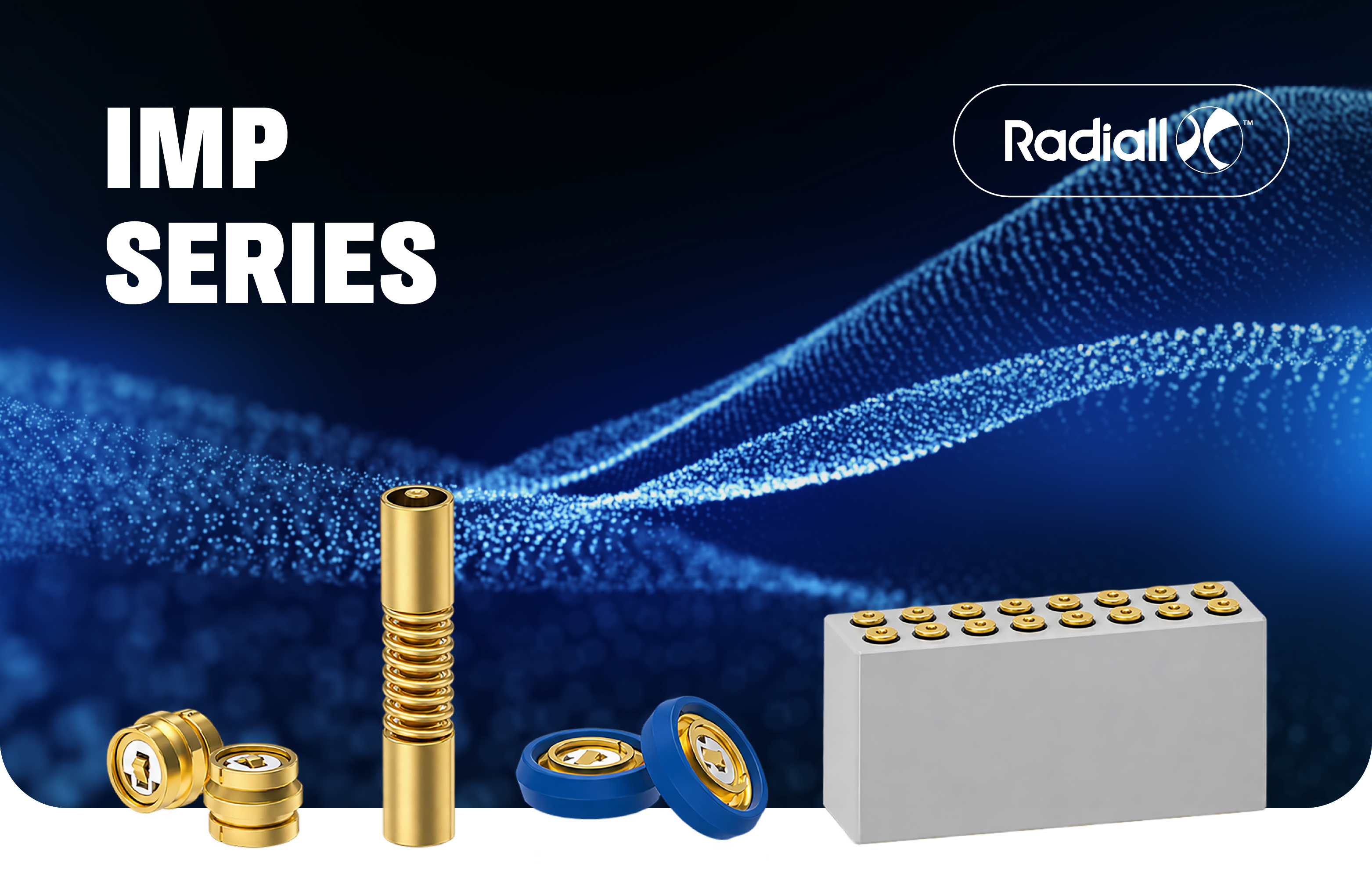
IMP: High-Performance Connectivity in a Compact Design
In advanced beamforming systems (Radar, Satcom, Electronic Warfare), the RF front-end—specifically the dense interconnect layer between the antenna array and the Transmit/Receive (T/R) modules—represents one of the most critical design challenges. While conventional board-to-board connections rely on a complex assembly of three soldered components, the integration of vital cooling functions and structural cold plates quickly turns standard RF routing into a major bottleneck.
Designed for Easy Integration
Integration can be summed up in one simple concept: insert it into the cavity and you're connected.
The IMP technology streamlines integration by eliminating the need for complex soldering operations. The PCB only requires a gold-plated contact pad positioned opposite a cylindrical cavity. The component is then inserted directly into a machined recess within the shielding structure or cold plate. Once in place, electrical connectivity is established through mechanical compression, ensuring reliable contact without soldering, thermal processing or additional assembly steps. This straightforward approach simplifies manufacturing, reduces assembly complexity and enhances overall system reliability.
Key Benefits
-
One Single Component Instead of Three
By replacing the traditional three-component board-to-board configuration, typically used in SMP or SMPM systems, with a single integrated connector, Radiall’s IMP technology significantly simplifies procurement and inventory management. This streamlined approach reduces the number of components required, minimizes bill-of-materials (BOM) complexity and helps optimize sourcing and assembly processes. Fewer parts also mean fewer potential points of failure, contributing to improved overall reliability and more efficient manufacturing.
-
High-Frequency Performance in a Small Footprint
Designed for frequencies up to 40 GHz, the IMP Family ensures excellent signal integrity with insertion loss reduced by a factor of 2 to 3 compared to conventional three-component architectures, reaching as low as 0.2 dB at 40 GHz. The IMP-SR configuration also offers low crosstalk, ensuring reliable signal transmission and effective isolation in demanding high-frequency applications.
-
Ultra Compact Design
Accommodates tight board-to-board spacing starting at just 1.41 mm. By embedding directly into the wall thickness of the shielding structure, it saves valuable PCB real estate and simplifies trace routing. With a minimal diameter of just 2.33 mm, it ideally supports the tight pitch requirements of ultra-high-density beamforming systems, including multi-polarization architectures.
-
Rugged Reliability in Harsh Environments
Eliminating soldering prevents gold-embrittlement cracking during thermal cycling. The design withstands 20 g vibration levels (compliant with MIL-STD-202 Method 204 Condition D) and is space-evaluated.
-
Solderless Technology for Easier Integration, Accelerating Calibration and Field Maintenance
The IMP Family’s solderless pressure-contact design simplifies assembly, testing and maintenance by eliminating the need for soldering at the interconnect point. It enables instant RF testing using dedicated calibration test jigs, significantly reducing bench time. Component replacement and maintenance can also be performed directly in the field without desoldering equipment, offering greater flexibility and reducing downtime.
Designed and manufactured in France, the IMP solution is completely ITAR-free, ensuring unconstrained global deployment.
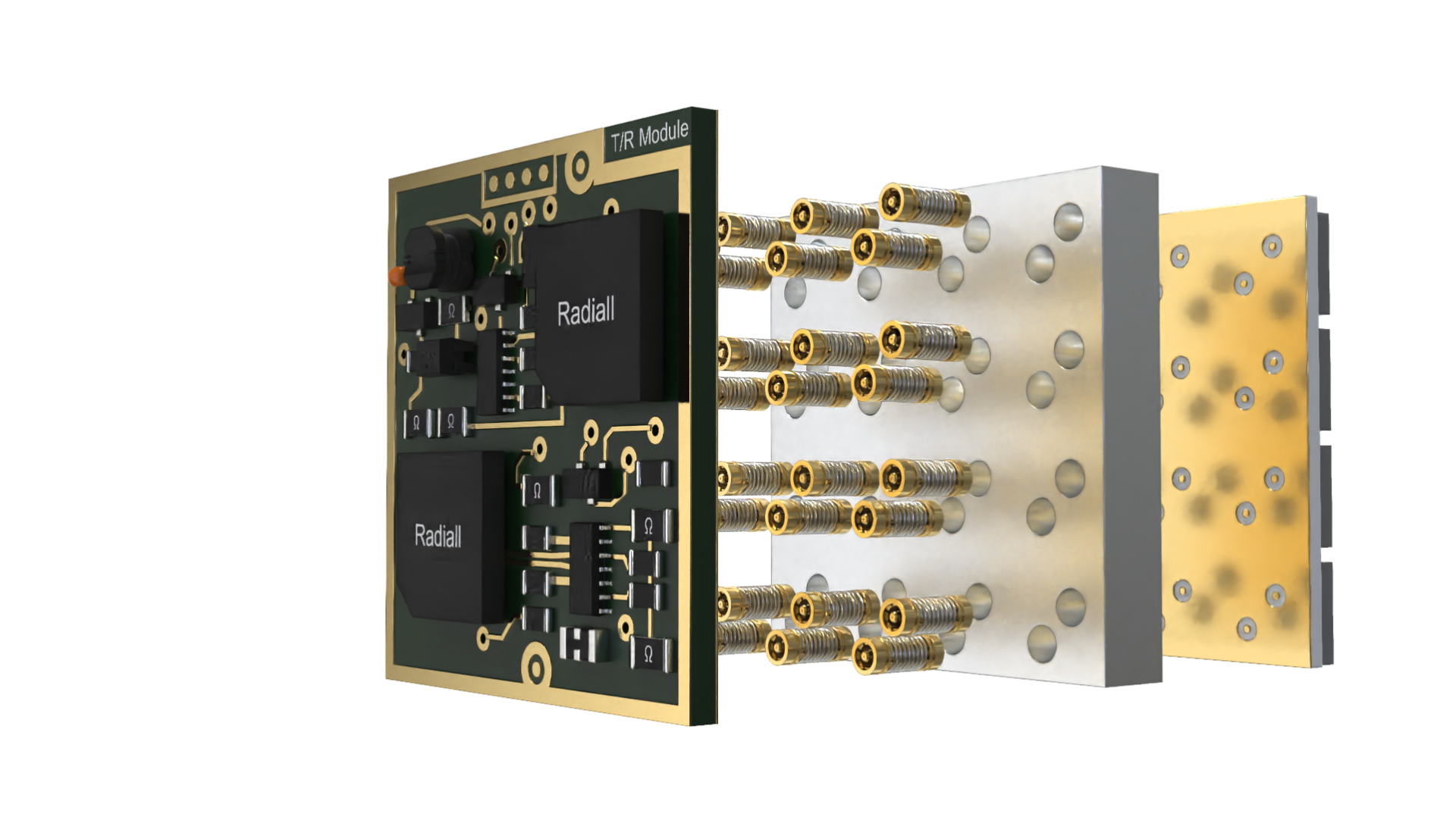
Flexibility Across Different Applications
To address the distinct requirements of various markets, Radiall has expanded its IMP portfolio into specialized variants: IMP-LP (Low Profile), IMP-HD (High Density), and IMP-SR (Signal and RF). Designed for maximum integration flexibility, these solutions are available in a wide range of configurations—including board-to-board, board-to-cable, parallel, card-edge, and multi-point layouts—to seamlessly adapt to any high-frequency system architecture.
Supporting the Next Generation of RF Systems
As radar, antenna and communication technologies evolve, interconnects have an increasingly important role to play in overall system performance. Engineers need solutions that can keep pace with higher frequencies, tighter packaging requirements and more complex architectures.
Discover how the IMP Family can support your high-frequency connectivity requirements.